


Introduction
Hiring urgency has a way of feeling justified in the moment. Delivery pressure mounts, a gap becomes visible, and filling the role appears to be the most rational response. Individually, these decisions make sense. Collectively, they shape a workforce that often behaves very differently than intended.
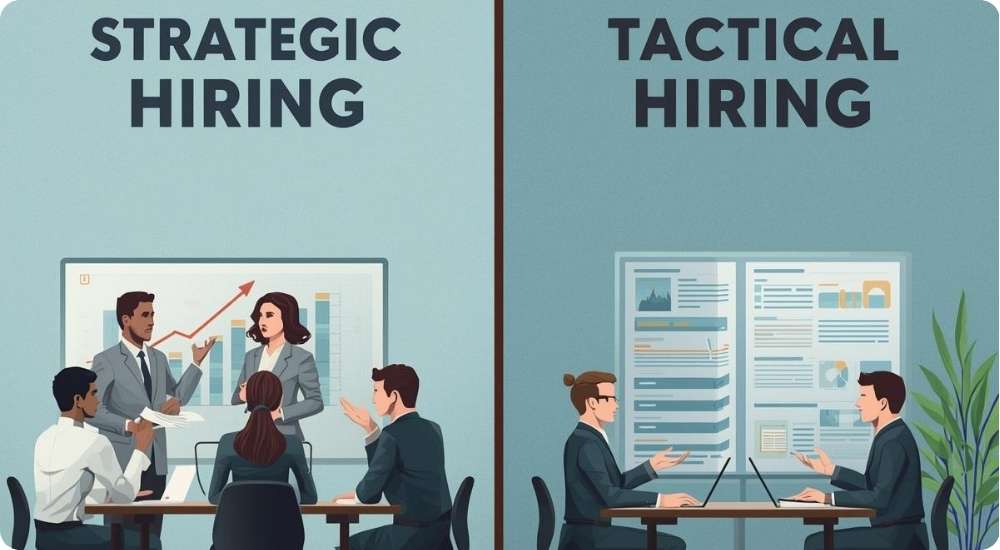
The difference between strategic and tactical hiring sits in time horizon rather than intent. Tactical hiring resolves immediate constraint. Strategic hiring considers how each decision alters capability, leadership load, and execution quality over time. Organizations that fail to distinguish between the two rarely notice the impact until coordination slows and correction becomes costly.
Tactical Hiring Solves Today’s Problem
Tactical hiring is reactive by design. A team is overloaded. A project slips. A skill gap becomes visible. The response is to hire quickly to relieve pressure.
There is nothing inherently wrong with this approach. Tactical hiring is often necessary to keep organizations moving. The risk emerges when it becomes the default mode.
Common characteristics of tactical hiring include:
- Roles defined narrowly around immediate tasks
- Speed prioritized over long term fit
- Limited consideration of downstream impact
- Minimal integration with workforce planning
Over time, repeated tactical decisions create a workforce optimized for yesterday’s problems rather than tomorrow’s challenges.
Strategic Hiring Shapes Tomorrow’s Capability
Strategic hiring begins with a different question. Instead of asking what problem needs solving now, leaders ask which capabilities the organization must strengthen to remain effective as it scales.
This approach treats hiring as a design decision. Each role is evaluated for how it contributes to system level outcomes rather than short term relief.
Strategic hiring typically focuses on:
- Roles that unlock multiple teams
- Leaders who increase decision quality beyond their scope
- Capabilities that reduce future hiring volume
- Talent that can adapt as priorities shift
The payoff is not immediate. It shows up in reduced rework, stronger leadership benches, and clearer execution over time.
The Cost of Over Indexing on Tactical Hiring
Organizations that rely too heavily on tactical hiring often experience similar symptoms. Headcount grows, but coordination becomes harder. Leadership time shifts toward alignment rather than strategy.
This happens because tactical hires are rarely designed to scale influence. They fill gaps without reducing underlying complexity.
Common downstream effects include:
- Overlapping responsibilities and unclear ownership
- Increased dependency on a small number of senior leaders
- Slower decision making as teams expand
- Higher attrition as roles lose coherence
What begins as speed eventually becomes drag.
Strategic Hiring Requires Saying No More Often
One of the hardest aspects of strategic hiring is restraint. It requires leaders to delay or decline hires that do not strengthen the system, even when pressure is real.
This does not mean ignoring urgent needs. It means addressing them in ways that do not compromise long term design.
Organizations practicing strategic hiring often:
- Re scope roles before approving headcount
- Consolidate responsibilities rather than fragment them
- Use flexible capacity selectively instead of permanent hires
- Hire fewer people with broader impact
Saying no to the wrong hire is often more valuable than saying yes quickly.
Timing Determines Which Approach Is Appropriate
Strategic and tactical hiring are not mutually exclusive. The challenge is knowing when each is appropriate.
Early stage teams often rely more on tactical hiring due to limited resources and fast changing needs. As organizations scale, the cost of tactical decisions rises.
Mature organizations become more deliberate. They reserve tactical hiring for genuine exceptions and anchor most decisions in strategy.
The inflection point usually appears when:
- Hiring volume increases without proportional output gains
- Leaders spend more time coordinating than deciding
- Teams struggle to understand ownership
At that point, strategy must lead hiring decisions.
Hiring Signals Reveal the Underlying Approach
The difference between strategic and tactical hiring is visible in how roles are evaluated.
Tactical hiring tends to emphasize:
- Immediate experience match
- Short ramp up time
- Familiar environments
Strategic hiring emphasizes:
- Learning velocity
- Judgment under ambiguity
- Ability to influence beyond role boundaries
These signals predict different outcomes. Tactical signals optimize for speed. Strategic signals optimize for durability.
Workforce Planning Is the Bridge Between the Two
Organizations that manage the balance well use workforce planning as a bridge. Planning does not eliminate urgency, but it contextualizes it.
When leaders understand upcoming capability needs, tactical hires are made with greater awareness of their impact. Strategic hires are timed to reduce future pressure.
Effective planning connects:
- Product and technology roadmaps
- Leadership capacity and succession
- Hiring priorities and sequencing
Without this connection, hiring oscillates between extremes.
Strategic Hiring Strengthens Leadership Capacity
One of the most underappreciated benefits of strategic hiring is its impact on leadership bandwidth. Leaders hired strategically reduce the cognitive and decision load on others.
They clarify direction, develop people, and create leverage. Over time, this allows the organization to absorb growth without constant escalation.
Tactical hires rarely provide this leverage. They often require additional oversight, increasing leadership strain rather than relieving it.
Frequently Asked Questions (FAQs)
1. Is tactical hiring always a mistake?
No. Tactical hiring is sometimes necessary to address immediate pressure. The risk arises when it becomes the dominant hiring mode.
2. How can organizations shift toward more strategic hiring?
By clarifying long term capability needs, strengthening workforce planning, and evaluating hires based on system impact rather than immediate relief.
3. Does strategic hiring slow growth?
It may slow short term hiring volume, but it improves long term execution by reducing rework, misalignment, and leadership strain.
4. What is the clearest sign that hiring has become too tactical?
When headcount grows but decision making slows and leaders spend increasing time coordinating rather than setting direction.
Conclusion
The difference between strategic and tactical hiring is not about intent. Most organizations hire with good intentions. It is about time horizon.
Tactical hiring optimizes for now. Strategic hiring optimizes for what comes next. Organizations that fail to balance the two accumulate complexity that is difficult to reverse.
For technology leaders, hiring is one of the few decisions whose impact compounds quietly. Choosing when to act tactically and when to hire strategically determines whether growth strengthens the organization or stretches it thin.